

Overview
PRFlow delivers GitHub pull request notifications to Slack. For each pull request it posts one Slack message that updates in place as the PR progresses — CI check status, reviews, and merge state all appear on the original message, and PR comments are synced into a Slack thread under it. Unlike the GitLab integration, there is nothing to configure on the GitHub side beyond installing the PRFlow GitHub App: the App delivers webhook events automatically and grants PRFlow its (read-only) API access in one step. PRFlow works with github.com organizations and personal accounts; GitHub Enterprise Server is not supported. The App is published on the GitHub Marketplace as PRFlow for Slack, listed under Code review and Chat with a free Starter plan.Setup
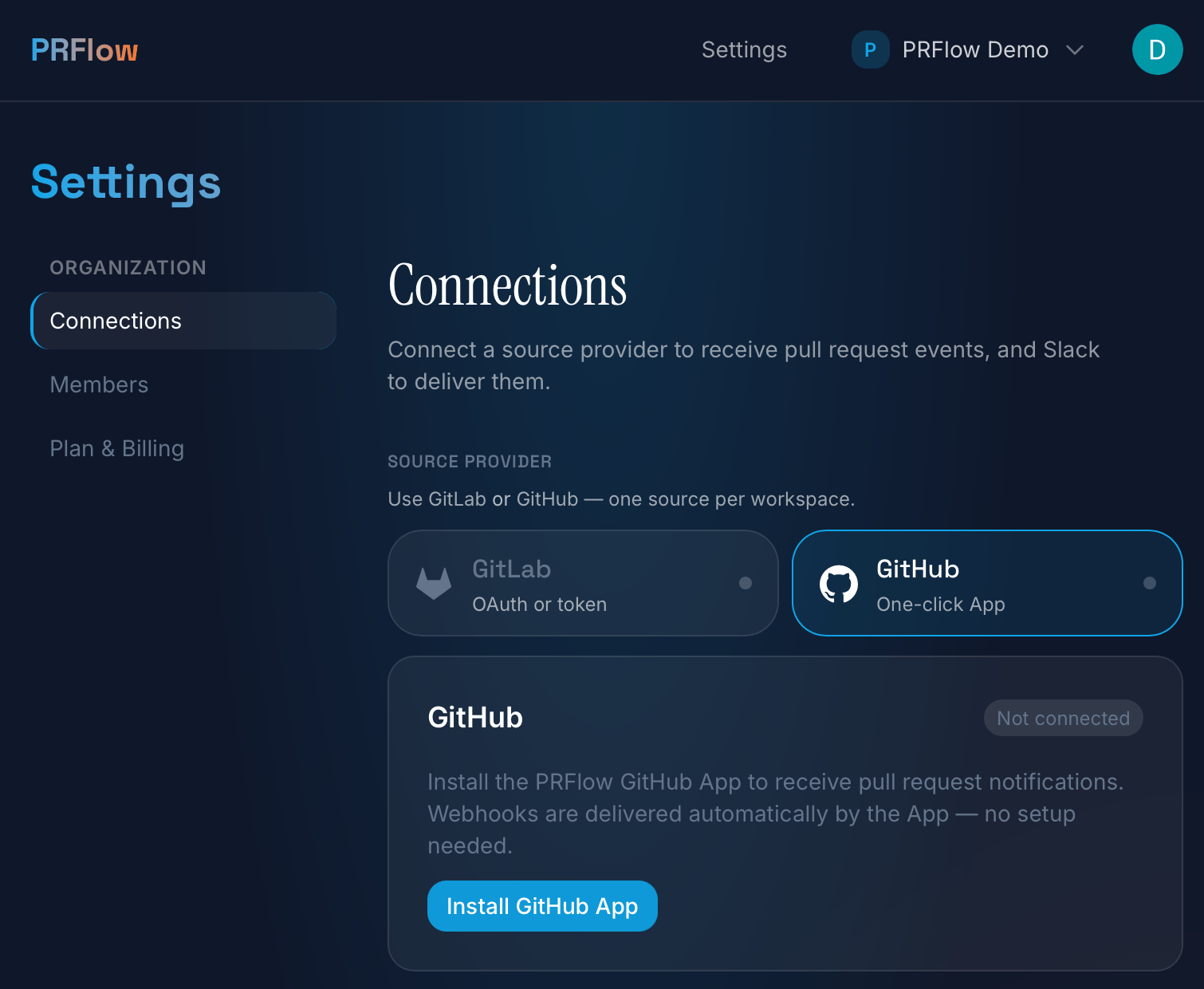
Settings → Connections — pick GitHub as the source provider and install the App.
- In PRFlow, open Settings → Connections and select GitHub as the source provider. A workspace connects one source provider — GitHub or GitLab, not both at once.
- Click Install GitHub App. GitHub asks you to pick the account or organization and which repositories the App may see (all, or a selected list), and shows the read-only permissions it requests — the full list, and why each one is needed, is in Permissions & data below.
- Back in PRFlow, connect Slack if you haven’t yet, then map repositories to Slack channels from the dashboard.
You can also start from the
GitHub Marketplace listing
and install the App there first. GitHub then sends you to PRFlow to link the
installation to your workspace — sign in (or sign up) and press Connect
GitHub on the Connections page to finish. The end result is identical to
starting from inside PRFlow.
How it works
Events PRFlow reacts to
The GitHub App subscribes to pull request activity. Events for repositories you haven’t mapped to a Slack channel are acknowledged and discarded.Slack message model
The Slack side is identical to the GitLab integration: a 1:1 mapping between a pull request and a Slack message, updated in place viachat.update, with
merge-requirement rows that flip from 🔴 to 🟢 as CI, approvals, and
mergeability are satisfied. On GitHub the merge requirements are read from
the repository’s branch rulesets; repositories using classic branch
protection (which the App’s read-only permissions cannot inspect) get a
conservative fallback that never overstates what is required.
Comment sync: each PR comment becomes a threaded reply under the PR
message, quoting the comment text (truncated to 2,000 characters) with the
commenter’s username. Comment edits on GitHub update the existing thread
reply; comment deletions remove it. PRFlow retains the comment text along
with the comment ID and the Slack message reference — see
data handling, which applies equally to
GitHub.
Permissions & data
The App requests four read-only permissions:
The Issues permission was added in August 2026 to carry conversation
comments — there is no PR-only way to receive them from GitHub. If you
installed the App before then, GitHub shows organization owners a one-time
request to approve the new permission. Everything else keeps working while
the request is pending, and conversation comments start syncing the moment
it is accepted.
PRFlow has no write access and no Contents permission, so it cannot read
repository code or diffs, and it cannot modify anything on GitHub. Every
webhook delivery is signature-verified (
X-Hub-Signature-256) before it is
processed. As with GitLab, only pull request, review, comment, and check
metadata is handled — see the GitLab page’s
data handling section for the storage
and Slack-delivery details, which apply equally here.